
Data Is Becoming the New Language of Agriculture
- Viraj Weerasooriya

- Jun 22
- 6 min read

Sometimes one question captures an entire industry shift
Recently, I had a conversation with a senior planter from Malaysia. More than 25 years in palm oil. He did not open with theory or assumptions. He asked one simple question:
"Did you check the data? Is the trend going up or down?"
That question stayed with me.
Because in that one question, he captured exactly where agriculture is heading. Not toward dashboards. Not toward technology for its own sake. Toward evidence. Toward the discipline of knowing what is actually happening — not just what we think is happening.
The field still matters. But the field alone is no longer enough
For generations, plantation decisions were shaped by field experience. A good planter can walk into a block and observe things that no system can fully replicate: crop condition, canopy quality, soil feel, worker behaviour, drainage, plucking or tapping standard, accessibility. Whether the crop is tea, rubber, coconut, or oil palm, that hands-on judgment is real. It is earned. It matters enormously.
But today, the field has to be read alongside data.
A field may look green, but yield per hectare may be declining. Harvesting may be happening daily, but the interval may be too long and losses accumulating silently. Labour may be present at roll call, but productive output may be well below target. A division may appear well-managed, but crop data may be distorted underneath.
Without data, many of these gaps remain invisible — until they have already caused a loss.
The real transformation starts when the field can speak to the system
What field observation hides — and what data reveals
There is a particular kind of management confidence that builds up over years of field experience. You know the blocks. You know the supervisors. You have walked those rows enough times to sense when something is off.
That confidence is valuable. But it has a blind spot.
Field observation captures what is visible at the moment of visit. Data captures what is happening across time. And in plantation agriculture, the most damaging losses are almost never visible in a single field walk. They accumulate quietly — across rounds, across weeks, across seasons — until they show up as a yield shortfall, a quality rejection, or a cost overrun that nobody saw coming.
The five gaps below are ones I have encountered repeatedly across plantation operations. They are not exceptional. They are common. And in most cases, the field looked fine.

These gaps share one characteristic: none of them are visible through observation alone. The field looks managed. Work is happening. Crop is moving. But underneath, something is eroding — yield, quality, accuracy, or cost.
The question is not whether your team is working. They are. The question is whether the system is capturing what is actually happening — accurately enough, and early enough, to act.
Digitisation does not begin with a dashboard
This is the lesson that took me the longest to articulate clearly — because it cuts against the way most digital transformation projects are sold.
The pitch is usually about the output: a live dashboard, a mobile app, a management report that updates in real time. And those things are genuinely useful — when the foundation beneath them is solid.
But in plantation environments, the foundation is rarely solid at the start.
Data quality problems do not begin at the analytics layer. They begin at the point of capture. A field record entered against the wrong block. A harvest weight recorded by memory at the end of the day rather than at the point of weighing. A labour allocation logged in a register that nobody cross-checks. A plucking round marked complete when three sections were skipped.
None of these errors are visible in a dashboard. They are embedded in the data the dashboard is reading.
Before any mobile application, ERP workflow, GIS layer, or analytical report can create real value, three things have to be in place: the discipline to capture data at the point where work happens, the process design to make that capture accurate and consistent, and the connectivity infrastructure to move that data from the field to the system without it being transcribed, reinterpreted, or lost.
That foundation work is unglamorous. It does not make for a compelling board presentation. But without it, every dashboard you build is telling a story about the data — not about the plantation.
The plantation as a connected operating flow
A plantation is not a collection of independent activities. It is a chain. And like any chain, its strength is determined by its weakest link.
Every day, across every division, the same sequence plays out:
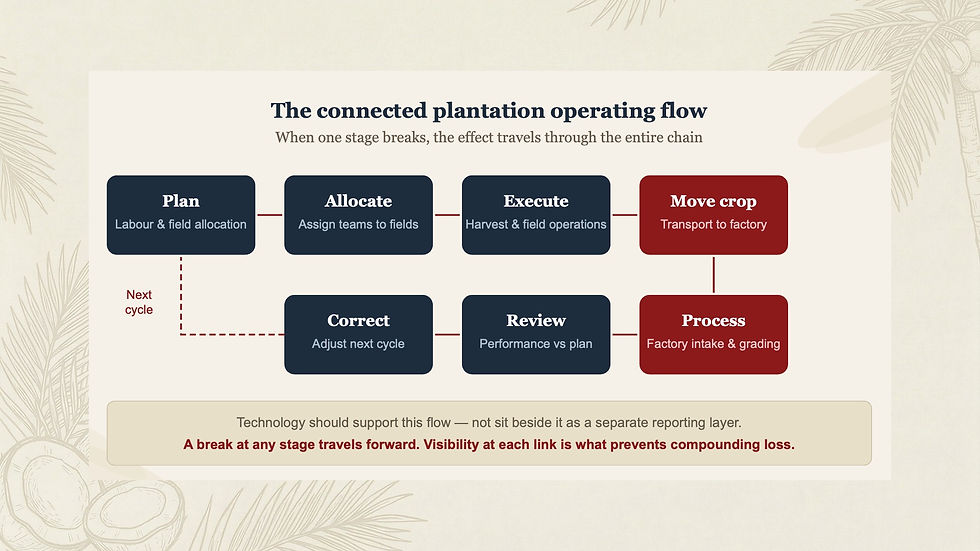
When that chain is working, value flows through it. When it breaks at any point, the effect does not stay local — it travels forward.
A plucking round delayed by two days does not just mean late harvest. It means coarse leaf at the factory, a grade rejection, and a revenue number that looks like a market problem when it is actually a field discipline problem. A harvest weight recorded incorrectly does not just affect one day's data — it distorts the division performance report, misrepresents the field's yield potential, and sends the wrong signal to whoever is making the next allocation decision.
A transport delay means crop arrives off-grade. A skipped field audit means a compliance gap that surfaces three months later during certification. A report that reaches management two weeks after the event means the window to correct has already closed.
In each case, the loss was preventable. What was missing was not effort — it was visibility, at the right point in the chain, at the right time.
This is where technology creates its real value in plantation operations. Not by generating more reports. But by making the chain visible — so that when something breaks, it is caught before it compounds.
When the operating flow is digitised end to end, the management conversation changes. It moves from "what happened last month" to "what is happening now, and what do we do about it before it becomes a problem."
From reporting to decision-making
Most plantation businesses already produce reports. Weekly summaries. Monthly performance reviews. Harvest tallies. Labour attendance sheets. Cost statements.
The problem is not the absence of reporting. The problem is what reporting alone cannot do.
A report tells you what happened. It documents the past. It confirms what has already been lost or gained. By the time it reaches the person who needs to act on it, the window to intervene has often already closed.
Decision-making requires something different. It requires visibility early enough to change the outcome — not record it.
The shift looks like this: instead of learning at month-end that a division's yield trend has been declining for six weeks, you see it at week two and ask why. Instead of discovering after the fact that crop was transported late and arrived off-grade, you know before the next load moves. Instead of receiving a labour productivity summary that covers the previous fortnight, you have a daily picture that tells you where output is below target and which fields are at risk.
This is not about more reports. It is about faster signal — closer to the point where work is happening, and early enough to matter.
The plantation businesses across Asia that have made this shift describe the same change: management stops being reactive and starts being anticipatory. The conversation in the morning meeting is no longer "what went wrong last month." It becomes "what do we need to correct today."
What Sri Lanka's plantation sector needs to do next
Sri Lanka's plantation sector has something that many agricultural industries lack: a long, structured history of field records, known boundaries, measurable labour inputs, and repeating cycles across tea, rubber, and coconut. The raw material for transformation already exists.
What is needed now is the discipline to connect it.
Not every estate needs to start with a sophisticated system. What every estate does need is a clear answer to three questions: Is our field data being captured accurately, at the point of work? Is our crop data moving through the chain without being distorted? And are our performance reports reaching decision-makers early enough to act?
If the answer to any of those three is uncertain, that is where to start.
The gap between the best-managed and worst-managed fields within the same company — on the same crop, in the same season — can be two times or more on the same measure. That gap does not close through harder work or better intentions. It closes through visibility.
The senior planter I mentioned at the beginning of this post was not asking a technical question when he said "did you check the data?" He was asking a management question. He was asking whether the team was making decisions based on evidence or assumption.
That question is available to every estate, on every crop, starting now. The answer depends on whether the system is built to provide it.
Data does not replace the planter's eye. It gives it a longer reach.

Comments